
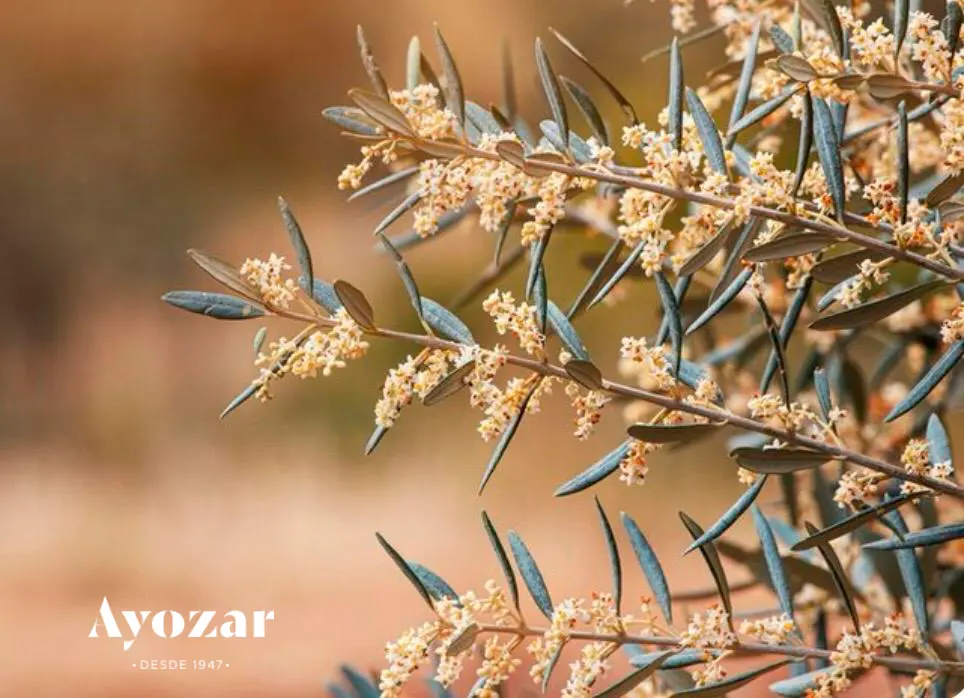
The olive tree flowering It is one of the most important phases in the annual cycle of this ancient tree and a decisive moment for the future production of olives. The quantity and quality of the olive oil, so understanding how it develops is essential for both farmers and those who value a product of careful origin.
In producing areas such as Andalusia, and especially in Jaén, flowering marks the beginning of a new campaign in the olive grove and is observed with special attention by professionals in the sector.
When does the olive tree bloom?
The olive tree blooms in spring, normally between the months of April and June.. However, this period may vary depending on factors such as climate, altitude, olive tree variety and growing conditions.
Before flowering, The olive tree goes through a period of winter rest. During this phase, the tree accumulates the hours of cold necessary for proper floral induction to occur. If this requirement is not adequately met, flowering may be irregular or less abundant.
With the arrival of milder temperatures and the increase in daylight hours, The olive tree activates its metabolism and begins to develop inflorescences, known as “rapas”.
What is the olive flower like?
The olive flower It is small, delicate and white or cream in color. It is grouped in clusters and usually goes unnoticed by the naked eye, although it plays an essential role in production..
There are two main types of flowers:
- hermaphrodite flowers: contain male and female organs and are the only ones capable of becoming fruit.
- Male flowers: they produce pollen, but do not generate olives.
The olive tree produces thousands of flowers each season, but only a small percentage become olives.. This phenomenon is completely natural and allows the tree to regulate its productive load.
Olive tree pollination: a natural process
The olive tree pollination It is mainly carried out by the wind, a process known as anemophilia. Pollen is transported from one flower to another thanks to air currents, which allows fertilization.
Although some olive tree varieties are self-compatible, cross-pollination between different varieties usually improves fruit set and increases production. For this reason, in many olive groves different varieties are combined to optimize performance.
Factors that affect the flowering of the olive tree
Flowering is a particularly delicate stage and can be affected by multiple external factors.. Among the most important are:
- Heavy rains during flowering, which make pollen dispersal difficult.
- High temperatures, which can reduce pollen viability and affect fertilization.
- strong winds, which interfere with the natural pollination process.
- Nutritional deficiencies, which affect the quality and quantity of flowers.
In addition, agronomic management plays a key role. Proper pruning improves aeration and light entry, favoring the formation of higher quality flowers.. Likewise, a correct balance between irrigation and fertilization contributes to more uniform flowering.
The fruit set of the olive tree: from the flower to the fruit
After pollination, theolive fruit set, which is the process by which the fertilized flower begins to transform into a small olive.
However, not all set flowers develop completely. The tree can abort part of the fruits if it does not have enough resources (water, nutrients, energy), which allows you to maintain a balance and ensure the quality of the rest of the harvest.
This process is key to determining the final production of the olive grove.
The olive tree harvest
One of the most characteristic phenomena of olive cultivation is the vecería, also known as production alternation. This means that the tree alternates years of high production with others of lower yield.
A very abundant flowering can put a lot of effort on the tree, reducing its reserves and affecting the following year's flowering. Therefore, crop management is essential to try to balance this alternation.
The importance of flowering in the quality of olive oil
Theolive tree floweringIt not only influences the quantity of olives, but also the final quality of the oil. A balanced flowering process, followed by good fruit set, allows you to obtain healthy and homogeneous fruits.
This translates into a olive oil with better organoleptic properties, greater stability and a more balanced profile.
In short, flowering is the first step of a process that culminates months later with the collection and production of the oil.
Tradition, nature and care of the olive grove
At Aceites Ayozar, we understand that everything begins in the tree. For this reason, we take care of each phase of olive cultivation, from flowering to harvesting, respecting nature's timing and applying practices that guarantee maximum quality. Because behind every bottle of AOVE PREMIUM there is much more than a product: There is a complex natural process, knowledge passed down for generations, and a constant commitment to excellence.