
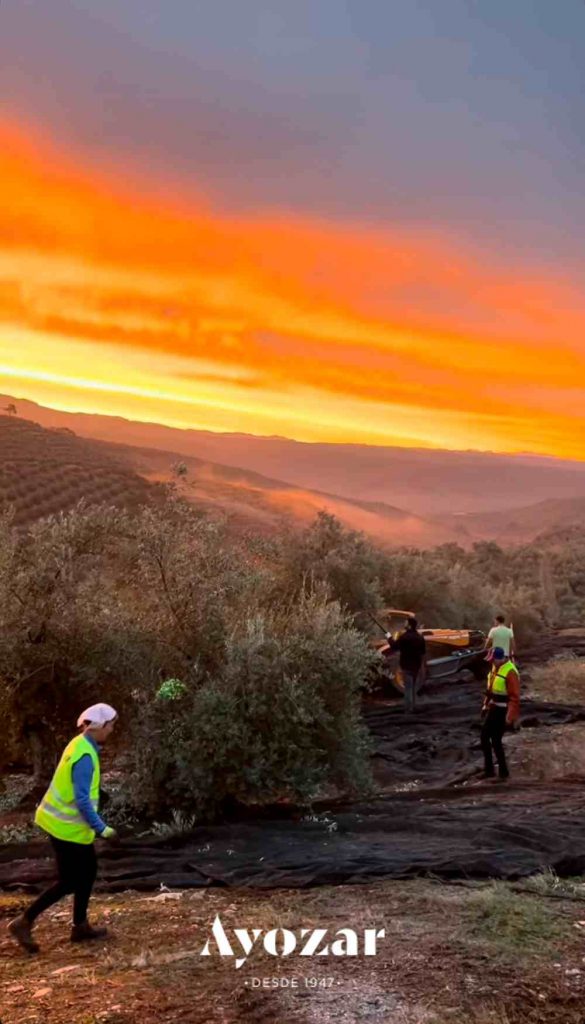
January is a key month in the olive grove calendar. As winter progresses and temperatures drop, The olive fields remain full of life thanks to the picual olive harvest, one of the most emblematic and appreciated varieties of our country. It's not just a matter of harvest: it's the result of months—and years—of care, knowledge, and respect for the land.
The picual olive stands out for its intense character, its high content of natural antioxidants and its stability, qualities that make it the basis of extra virgin olive oils of great quality. Harvesting it in January means finding the perfect balance between maturation and yield, achieving oils with body, personality and great sensory richness.
January: the decisive moment
During the previous months, the olive tree has gone through a slow and natural maturation process. In January, the picual olive reaches an optimal point in which the fruit has fully developed its qualities., keeping its properties intact. This moment is decisive: a late or careless harvest can affect both the flavor and the final quality of the oil.
Therefore, harvesting at this time requires precision and experience. Each plot, each tree and each campaign is different, and Only the farmer's knowledge allows him to make the right decisions: when to start, how to harvest and how to treat the fruit from the field to the oil mill.
Work in the field: effort that cannot be seen
Behind every bottle of oil there are long days, tanned hands and a deep respect for the land.. Harvesting in January is not easy: the cold, humidity and ground conditions make every day a challenge. Even so, farmers continue forward, aware that care in this phase is decisive to obtain excellent oil.
The olives are picked with care, avoiding bumps and damage that could affect the fruit. The objective is clear: that the olive reaches the oil mill in the best possible conditions., preserving all its aromatic and nutritional potential. The speed between harvesting and grinding is key, and the farmer's coordination and experience play a fundamental role in this.
Tradition that evolves
Although olive harvesting is an ancient tradition, it has also managed to evolve. Today modern techniques coexist with knowledge inherited from generation to generation.. Machinery that makes work easier, systems that respect the tree and more efficient processes are combined with the same love for the countryside as always.
The picual variety, so linked to our agricultural culture, is a reflection of this union between past and present. Its intensity, its aroma and its flavor tell us about the territory, the climate and the human effort behind each campaign.
The value of the farmer
Talking about the picual olive harvest in January is, above all, talking about the people who make it possible. Farmers who know each olive tree, who interpret the language of the land and who They work with patience and perseverance to offer an honest and quality product..
Thanks to them, he olive oil It is still much more than an ingredient: it is culture, it is identity and it is a fundamental pillar of our gastronomy. Recognizing their work is essential to truly value what we have on the table.
At Aceites Ayozar we firmly believe that quality is born in the field. For this reason, each campaign is a tribute to work well done, silent effort and passion for the olive grove. Because only by respecting the origin can we offer an oil that is at the level of the best tables.